📚 Hiawatha-Howe Elementary could close in district restructuring proposals
A deep dive on the neighborhood impact of proposed sweeping changes to school district boundaries.

Note: This story is free for everyone. For access to everything else, become a subscriber.
Hiawatha Elementary, Howe Elementary, and Longfellow Alternative High School are among 16 schools that could close after this school year, under newly unveiled proposals to reconfigure the Minneapolis Public Schools system. The overhaul could disperse neighborhood students to as many as four different elementary schools while significantly altering the boundaries of Dowling Elementary and Sanford Middle.
Background
Minneapolis Public Schools senior leaders presented the much-anticipated proposals to reconfigure the district to the school board at a meeting on Tuesday. District officials began talks of a "transformation" as early as 2023, citing financial troubles, declining enrollment, and underused buildings. That came just three years after another controversial reconfiguration, known as the Comprehensive District Design (CDD), made sweeping changes to school boundaries but didn't close any buildings. The last major round of closures came in the mid-2000's, which included the Cooper School.
Tuesday's meeting was the first time the details of the plan had been shared with the public. Because it was a work session, there was no public comment period, but a packed room watched the three-and-a-half-hour meeting, offering cheers and jeers at the sharing of key details.
Leaders and some board members characterized the plan as a painful-but-necessary readjustment to adapt to declining enrollment numbers, in a district of 30,000 students currently built to house about 43,000. In particular, they focused on the benefits of having schools full enough to offer a full range of programming and ancillary services, which they described as offering "a guaranteed MPS experience."
Critics have raised concerns that the plan doesn't include any details on how or whether the changes would help the district's troubled finances, and argued that further disruption would cost MPS in the long run by driving students to other districts. Currently, nearly half of K-12 students who live in Minneapolis attend school outside the district. Many also expressed concern about the turnaround time of the decisions, which are proposed to go into effect next school year.
Lori Norvell, the outgoing Board member who represents Longfellow, didn't weigh in on specific closures but defended the timing of the proposals, which she described as overdue after three years of public conversation. Becca Dryden, the frontrunner to win Norvell's vacated seat in November, said she was "disturbed" by the plan, which she and two other school board candidates later characterized in a Star Tribune op-ed as "absurd and reckless." (Molly Chase is running against Dryden for the seat, though without any major endorsements. She questioned the district's "assumption that this reshuffling of the deck doesn't turn away parents" like the CDD and other closures did.)
The proposals
The 118-slide presentation outlined three proposals that would modify elementary, middle, and high school boundaries, while shifting specialty programming around and closing — or "unprogramming," in the parlance of the proposals — as many as 16 facilities.
In Longfellow, all but a few blocks near the river would see a change in their community school pathway under one of the proposals. (Each address in the city is assigned a "pathway" of a community elementary, middle, and high school; families who want to attend a magnet school or different community school must enter a lottery. The new proposals would give students within walking distance of a school outside their pathway a better chance of getting a spot in the school.)
Perhaps most notably, Options 2 and 3 propose closing Hiawatha-Howe Elementary, which serves a broad swath of neighborhood students south of 32nd Street and west of 46th Avenue. (The two operate as a joint school across two campuses, with grades K-2 at Hiawatha and grades 3-5 at Howe.) Option 1 would keep the schools with their same boundaries, but calls for eventually closing Hiawatha and moving all students to Howe, which would be renovated to add more space.
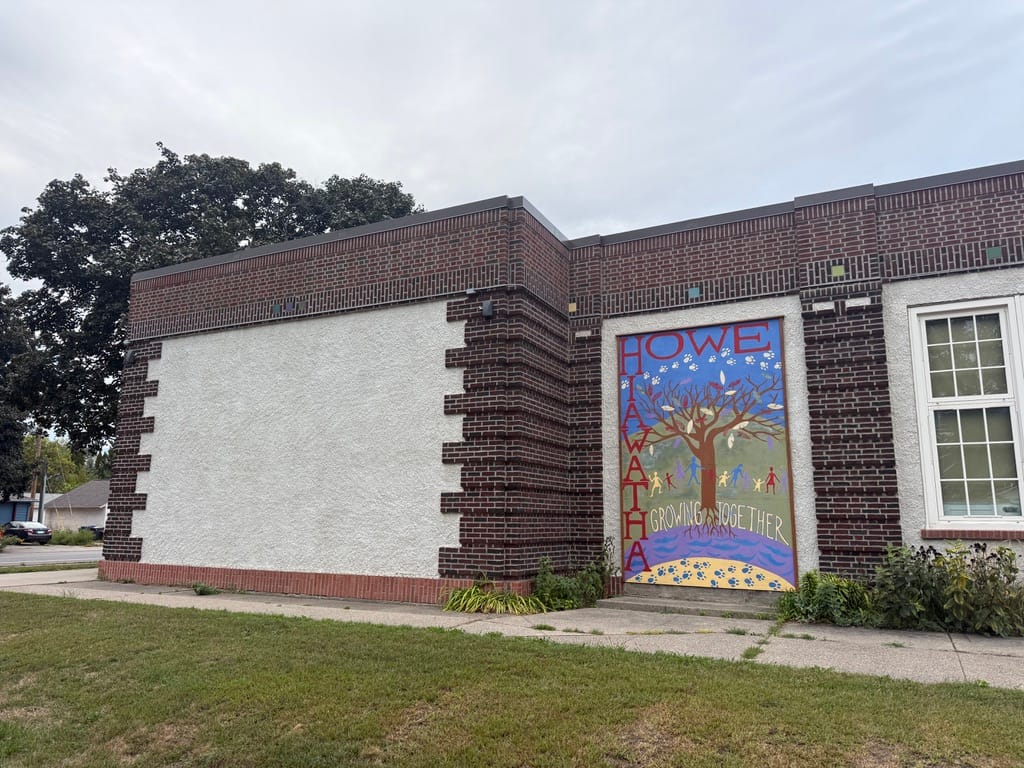
Hiawatha and Howe both have enrollment of more than 70 percent of their capacity, which MPS considers "efficient" usage. (At 85 percent, Dowling Elementary has the fifth-highest enrollment percentage of the 41 elementary schools.) However, Hiawatha's 110-year-old building was one of about a quarter of elementary school buildings the district considers in "poor" condition, lacking air conditioning and what evaluators call a "safe and welcoming entrance." Howe was given the highest rating.
The proposals say there would be no immediate plan for any shuttered school buildings, but note that they could become home to other MPS services, or someday be resurrected as schools if enrollment increases.
A closer look at each proposal's neighborhood impact:
Current boundaries
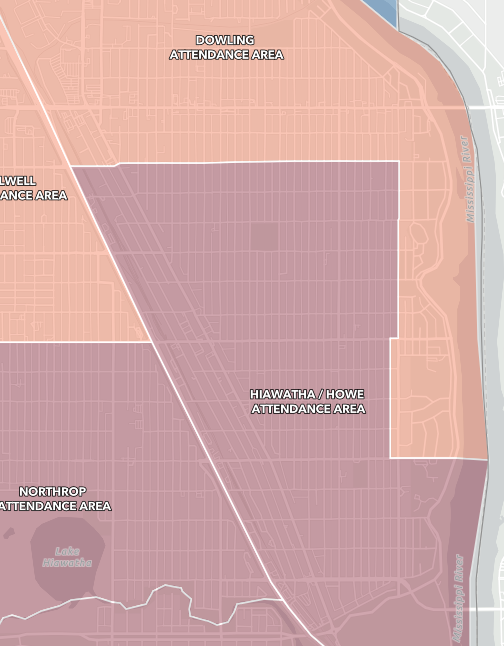
The CDD reclassified Dowling Elementary from a regional magnet school to a community school, with an L-shaped boundary that includes the area north of Lake Street up to I-94, and a riverside corridor east of 46th Avenue. Dowling students proceed to Andersen Middle School in the Phillips neighborhood and to South High School. The rest of the neighborhood goes to Hiawatha-Howe, which feeds into Sanford Middle and Roosevelt High.
Option 1
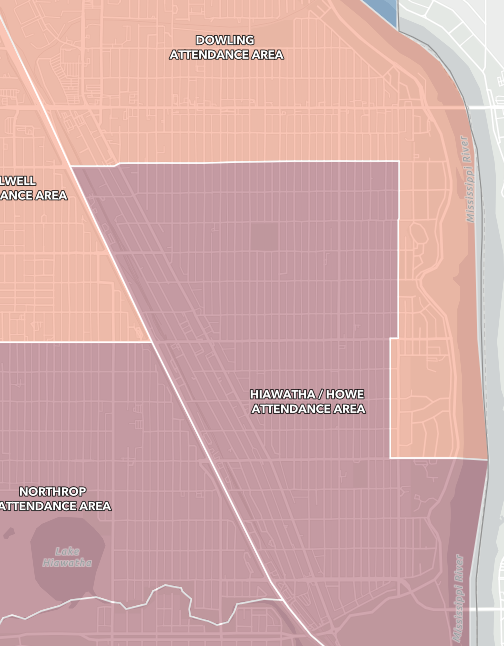
Option 1 brings the least change to the neighborhood, keeping the boundaries the same for Hiawatha-Howe, Sanford, and Roosevelt. Dowling School's boundary would expand north into Cedar-Riverside, absorbing students from the Pratt School that would close in Prospect Park. The plan calls for eventually closing Hiawatha and moving its students to a renovated Howe building.
Option 2
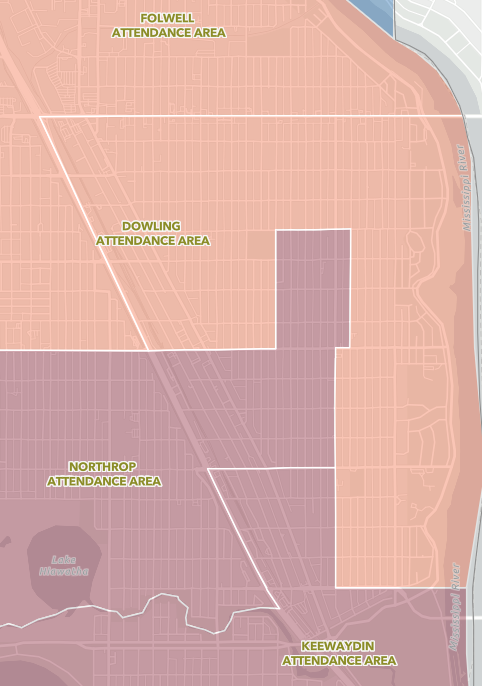
Option 2 proposes the most dramatic change in the neighborhood, dispersing students to four different elementary schools, three of which require crossing Hiawatha Avenue.
In the proposal, Hiawatha and Howe elementaries would both be shuttered. Students north of Lake Street would attend Folwell Elementary near 36th and Cedar, while a larger share of the neighborhood would attend Dowling. Both Folwell and Dowling students would attend Andersen Middle and South High.
An oddly-shaped slice in the middle would attend Northrop, located a few blocks east of Lake Hiawatha, and a southern segment of the neighborhood would attend Keewaydin, east of Lake Nokomis. Northrop and Keewaydin students would attend Sanford Middle and Roosevelt High School. (The jutting shape of the Northrop boundary would allow students who live immediately around Sanford to attend middle school there, instead of Andersen.)
Under this option, the proposal estimates that Sanford's enrollment would drop by more than a quarter, to about half of its capacity. Keewaydin Elementary would nearly double and Northrop would jump by about 20 percent.
Option 3
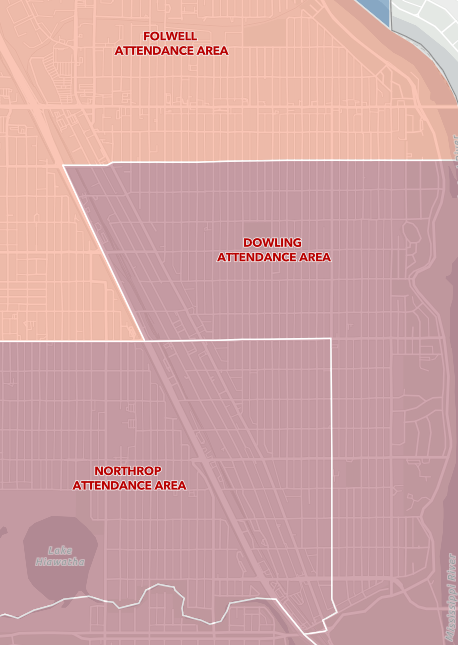
Option 3 also involves closing Hiawatha and Howe. It sends more neighborhood students to Folwell, expanding the border from Lake Street to 32nd Street. Those students would attend Andersen Middle and South High. The remainder of the neighborhood would be split between Dowling and Northrop. Dowling would switch pathways, feeding instead into Sanford and Roosevelt.
Magnet schools
Longfellow High School
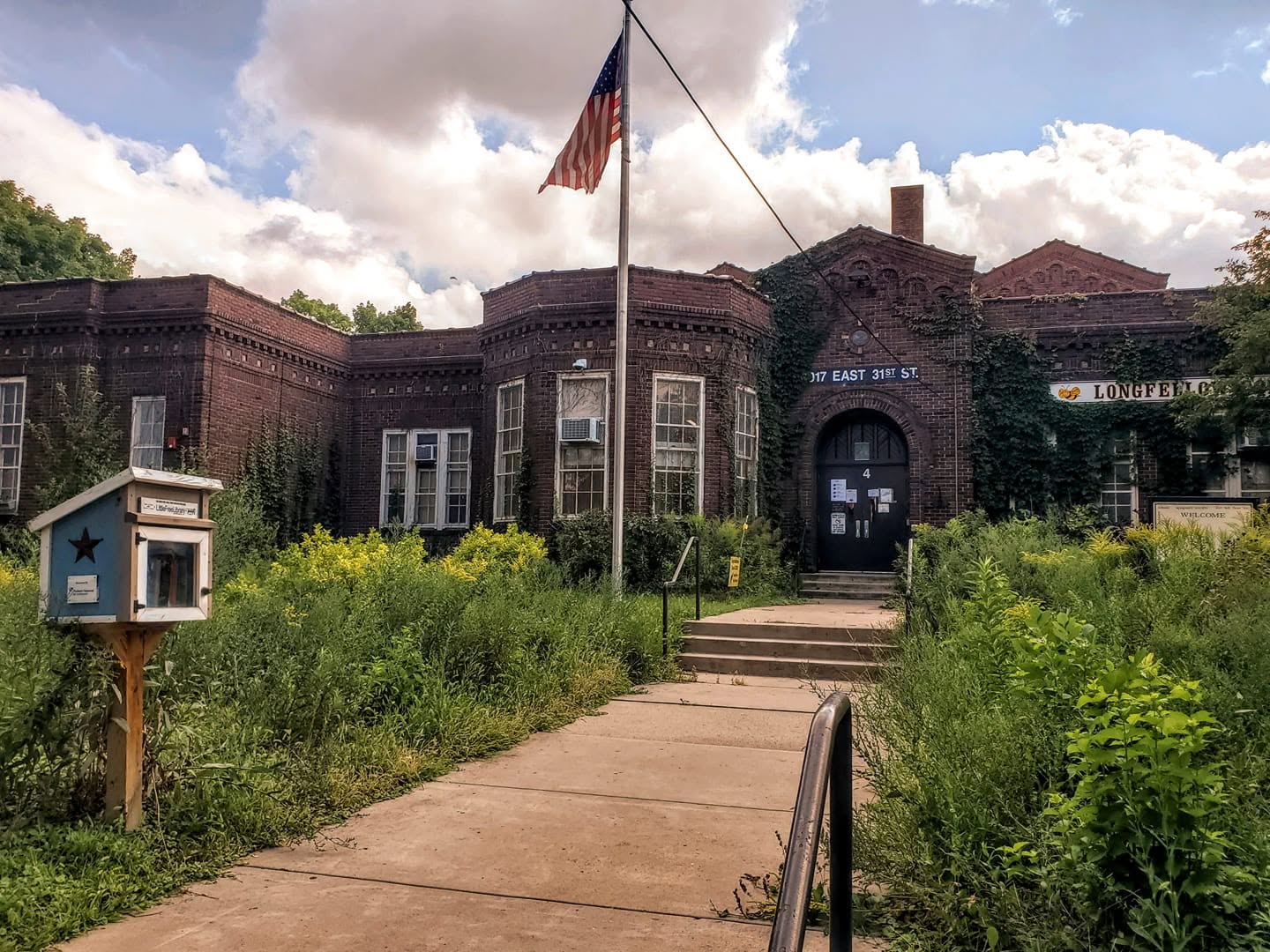
In all three proposals, Longfellow Alternative High School, which provides childcare and other services to about 40 teen parents inside the former Longfellow Elementary, would shutter and its services would be moved into North High School. The 108-year-old building at 31st and 31st operated as an elementary school until a small round of district closures in 2010, and most of its playground was quietly removed in 2023. It's unclear if the building would continue to house a popular Early Childhood Family Education program that provides classes for parents and young children.
Anishinabe Academy
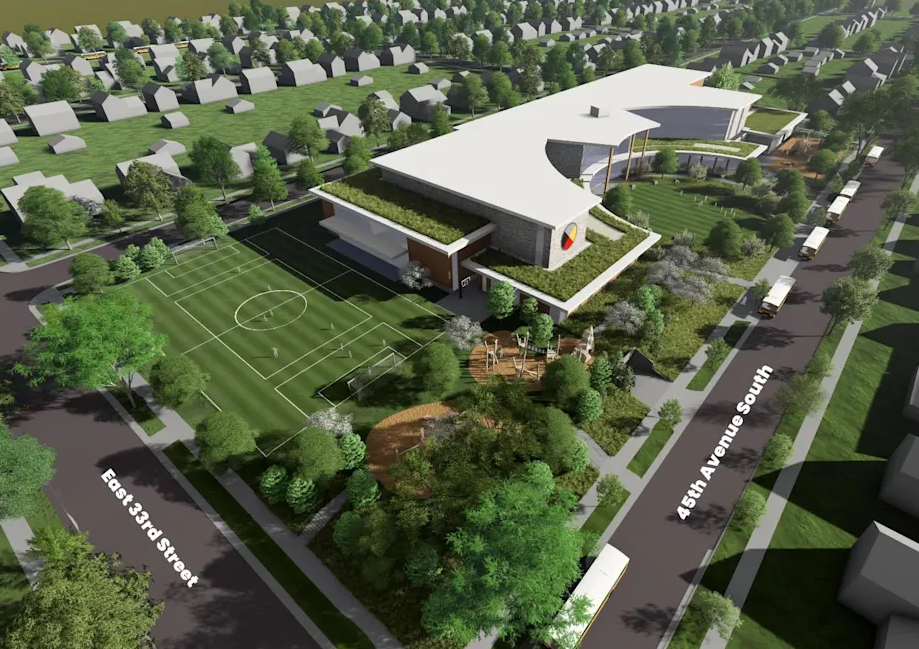
Plans are still moving forward to demolish the Cooper School and build a new Anishinabe Academy in its place, with construction slated to begin as soon as next year. All three options list Anishinabe as a PreK-8 in its new location, with students feeding to South High School.
District staff have not indicated that the new proposed closures will impact the plan for the $105 million project. Critics of the plan have urged MPS to reuse an existing building for the academy, which has shared space with Anne Sullivan since 2009 in an arrangement that was meant to be temporary. Project boosters say the school's unique needs benefit from a newly built facility, which would be funded from a separate capital budget.
District staff will present plans for the new Anishinabe building to the city planning commission today (Thursday) at 4:30. The commission's report says the school district does not anticipate needing any variances to city zoning code for the project.
Sullivan STEAM
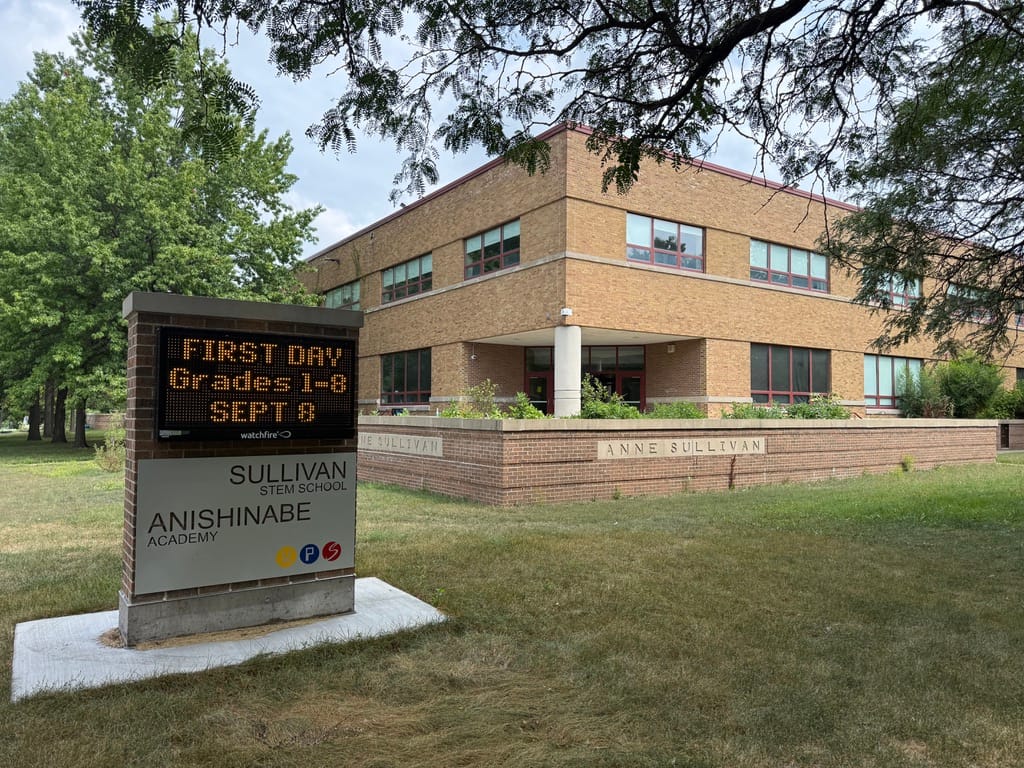
The CDD converted the Anne Sullivan School from a community school to a magnet school for science and engineering, renovating the media center into a robotics lab and maker space. The school also houses a Somali Language and Culture program. Sullivan will keep both programs and remain a K-8 school. STEAM students would continue to North High, and students in the Somali Language program would attend Edison High. The building would lose about 200 students when Anishinabe Academy moves to its new location.
Timeline
Tuesday's meeting was the Board's first time discussing the proposals, which could plausibly change significantly before any action is taken. The Board will meet again October 20 to review community feedback, and is scheduled to vote on the plan November 10 — a week after election day, when five of the nine elected board seats will be decided.
The parent organizations for Dowling Elementary and Hiawatha-Howe are each organizing their own school-specific meetings. Plans are in the works for a larger, neighborhood-wide meeting on the topic in the coming weeks.
Becca Dryden, the likely winner of the District 5 seat in November, will host her own meeting on the proposals on Monday from 6-8 at Venn Brewing. She's an organizer with the group Minneapolis Families for Public Schools, which sprang up in 2022 to support the teachers' union strike and which opposes closures. That group is hosting an online meeting Sunday at 4.
MPS will host a series of public meetings over the next month. Those include a meeting at South High on October 6 and at Roosevelt on October 9, both from 6-7:30. They're also collecting feedback via a survey that's open through October 16.