💸 Anatomy of a neighborhood aid fund
Under the hood of the neighborhood's largest mutual aid fund.
Note: This story is free for everyone. For access to everything else, become a subscriber.
Operation Metro Surge has created a shockwave of need — immediate, unforeseen, steep need — across the neighborhood and state. And the impulse to give has followed.
Homespun aid campaigns have cropped up in all shapes and sizes — fundraiser concerts, bake sales, food drives, and, in many cases, direct asks for money. And the money has shown up. One fund for people living in Powderhorn has raised $443,018. In Central, $356,041. In Phillips, $462,185. There are funds for individual schools, for individual day cares, for individual families.
Some incalculable millions of dollars have flowed into these unofficial aid funds the past two months. And as both the money and requests for it mount, the groups are wrestling with the fact that giving out money is a lot more complicated than it sounds.
In fact, much of the world’s bureaucratic brainpower is dedicated to the thorny problem of how to distribute money fairly and ensure it’s being used responsibly. Application periods, proposals, scoring rubrics, routine reporting, audits — all put in place in the service of distributing the money fairly, maximizing its effectiveness, and verifying its being used honestly. Speed and privacy are the tradeoffs for thoroughness and transparency.
But in a crisis like Operation Metro Surge, those tradeoffs become difficult or impossible. The need is too urgent, as pantries empty and rent comes due. The capacity is too limited, as many of the funds are distributed by non-professionals working on a volunteer basis, who have limited time or desire to formally evaluate requests. And, especially in this particular crisis, the need for privacy is too great to require much transparency, as reports circulate of agents tailing aid deliveries and the head of the FBI suggests that people involved in resistance efforts may be federally investigated.
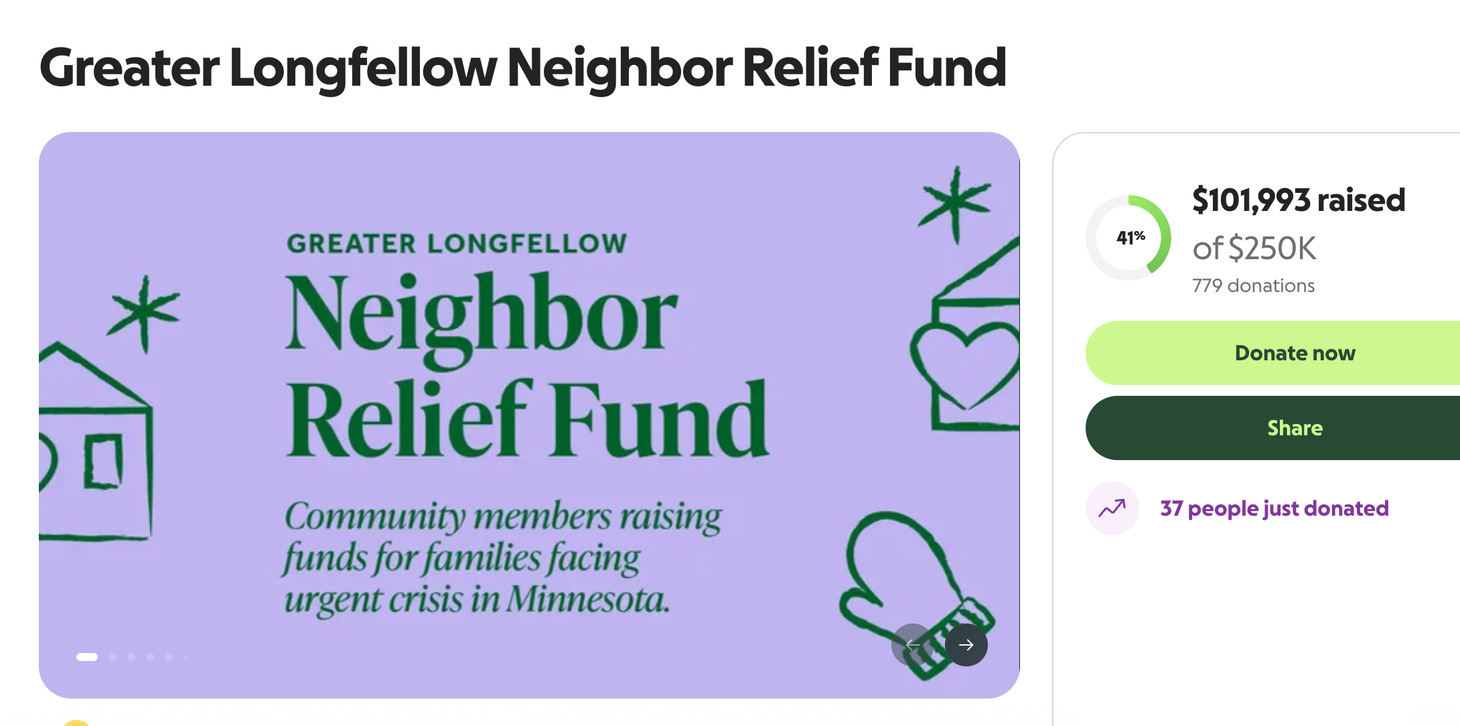
And yet, the funds continue to proliferate, operated by volunteers at great effort, and some risk, for no compensation. In Longfellow, the Greater Longfellow Neighbor Relief Fund has emerged as the largest general-purpose fundraiser focused on neighborhood families. The fund isn't particularly unique in its scale or scope; if anything, what makes it interesting is how typical such an unusual effort has become. I caught up with the group behind the fund to learn more about how it works and the scale of the effort — and trust — that makes it possible.
Background
The fund, like so many neighborhood organizing efforts this year, traces its roots back to the aftermath of the murder of George Floyd in 2020.
It’s a familiar story: A group of neighbors on a block near Lake and Minnehaha had urgent occasion to meet each other in the unrest that followed the killing. They held block meetings, coordinated lookout shifts, and established an encrypted group chat. In the years following, the meetings and group chat lived on, taking on more pleasant uses — borrowing a cup of sugar, organizing a yard party, offering up surplus treats.
When Operation Metro Surge began in December, the neighbors resurrected the group chat for something closer to its initial purposes, coordinating aid for a handful of families on the block who were now afraid to leave their homes. After the killing of Renee Good, they met in person to organize that aid more proactively – and, because, the heavy work of volunteering with your neighbors can also be fun, they capped the meeting with a sauna in someone's backyard.
Some shopped on the families' behalf. Others drove them around. And as rent came due, the group realized the needs of the families on their block exceeded what the neighbors could provide. One group member with experience organizing emergency fundraisers set up a GoFundMe, christened the "Longfellow North Fund," and the neighbors quietly distributed it within their networks. Word spread fast, and within 24 hours they'd raised $25,000 and closed the fundraiser a few days later after exceeding $50,000. "You have supported paying their rent, utility/internet bills, groceries, legal fees, and hospital bills, for now and in the months to come,” they wrote at the time.
In the days that followed, people from all over the state contacted the group, eager to build on their blueprint. Many were from the neighborhood. Ultimately, they decided to band together in a neighborhood-wide effort and christened it the Greater Longfellow Neighbor Relief Fund.
Inside the fund
Today, the group behind it is made up of more than 40 people throughout Longfellow and Seward, organized into a handful of committees. Some promote the fund. Others triage inbound requests. And others distribute the money or help shop with it.
They launched the fundraiser February 1. Though the group remained anonymous, the Longfellow Community Council, Ward 12 Councilmember Aurin Chowdhury, and numerous local businesses vouched for and promoted the fund, which was also spread widely across the many layers of neighborhood group chats.
Within two days it had raised almost $25,000 and within a week it was up to $44,000. Today, 17 days in, it's taken in more than $100,000, including more than a dozen donations of $1,000 or more.
As to the core questions of who should get the money, and how much, the group has opted for minimal process. Though they take requests via e-mail, most of the recipients come from personal connections within the group. The money is distributed on a first-come, first-served basis, and recipients aren't judged by any criteria nor asked to prove their need. The fund is ostensibly for people who live or work in Longfellow, but even on that front, the group has decided not to check or turn people away from outside the neighborhood.
There's no formula for determining the amount to give, either. Instead, recipients are instructed to ask for what they need and the group generally agrees to give them that amount. Their philosophy, like many mutual aid groups, is to let the families spend the funds as they see fit — both for practical reasons, since they don't have time or desire to verify purchases; and also to provide a measure of dignity for families who've lost much of their agency in other areas of life. They hear that most of the money goes to rent, household shopping, and legal fees. They find that families often ask for far less than they need, and sometimes have to cajole them to ask for more.
The group takes pains to protect their own identities and, even more so, the identities of the recipients. They ask for as little identifying information as possible when communicating with a family. Among themselves, they communicate on an encrypted group chat without using their real names, and save particularly sensitive matters for in-person meetings.
The group's treasurer keeps track of the disbursements in a shared spreadsheet, and offers to provide redacted proof of their spending to donors upon request. That person takes on particular exposure as the one who receives the money in their personal bank account and provides personal information to GoFundMe, which manually verifies the legitimacy of a fundraiser before releasing the money. (Fraudulent online fundraisers often pop up in the wake of tragic events; Attorney General Keith Ellison recently issued a statewide consumer alert for such practices.)
The group recently disbursed the first round of funding after it was released by GoFundMe, giving $33,345 to 26 families as cash or via a payment app. They're now distributing a second round of $49,104 and say they have more than 80 outstanding requests to fill.
They plan to keep the fund in operation for the foreseeable future, even as federal officials say they're wrapping up the operation, to help families catch up from the economic toll of the period. They've shifted outreach toward out-of-town donors, as the giving capacity of locals has slowed.
"Some days have felt overwhelming," one recipient wrote to the group. "There were moments when we didn’t know what we were going to do. But you were there. And that has meant more than what we can put into words."
You can donate to the fund at neighborrelieffund.org. Requests for aid can be made via e-mail to longfellowaid@proton.me.