🚂 When the bicentennial train pulled into Minnehaha Park
The steam-powered museum tour — both celebrated and mocked — drew record crowds to Minnehaha Park.
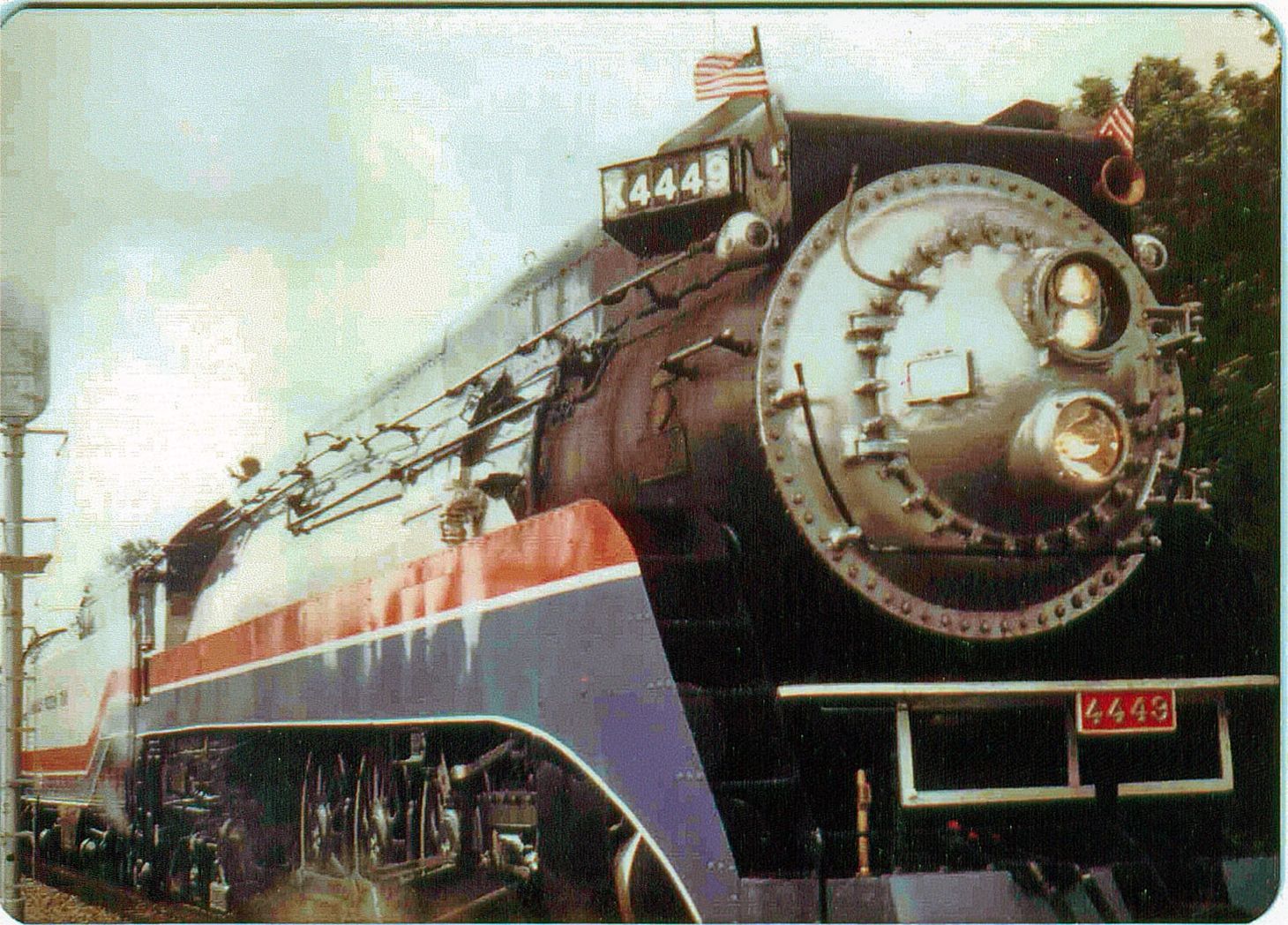
August 25, 1975, was one of those cool August days that signal the nearing of autumn. Which was a good thing for U.S. Senator Hubert Humphrey, who was dressed up — quite warmly — like a train conductor in overalls and a denim shirt, as he waited in the rail yards at Hiawatha and Franklin with his five-year-old grandson, Bucky, and a smattering of media and dignitaries.
He was about to board the bicentennial "Freedom Train," a 26-car, steam-powered locomotive loaded with hundreds of pieces of American history. Five months into a two-year journey through the lower 48 states, the train had just crossed the Mississippi for the first time and was now headed for a five-day stopover at one of the state's most important gathering places: Minnehaha Park.

Hubert and Bucky rode in the front of the train as it passed through Longfellow along the century-old Hiawatha rail corridor, shaded from the midday sun by the mills and manufacturing plants that lined it. They would've seen an industrial district in a state of decline but not extinction — many facilites had closed or would soon, but others chugged along, churning out flour and dog food and metal castings. Through the gaps in the industrial skyline, they would've seen Hiawatha Avenue in an in-between state of its own, cleared into a freeway-sized strip of land but still operating as a standard city road, flanked by vast open fields on the west side, a decade away from its conversion into a divided highway. To many, America itself felt trapped in a similar kind of limbo: Reeling from the disillusionment of Watergate and the Vietnam War, trying to muster a national pride amid a growing cultural reckoning with the brutalities of its past.
That's where the bicentennial celebrations came in. Across the country, organizations spent the years leading up to the 200th anniversary of the American Revolution planning events that would encapsulate the nation's story to that point — usually, though not always, in an explicitly patriotic light. The "Freedom Train" was one of the marquee events.
It was dreamt up by a young, train-enthused New York stockbroker, who conceived of it as a sequel to the popular 1947 Freedom Train that had toured the nation during another period of American identity crisis following World War II. (Which Humphrey had also boarded, 30 years earlier, as a young mayor of Minneapolis.) The broker secured donations from a handful of the nation's largest corporations to convert a series of classic railcars into moving museums, and sold tickets to cover the operating expenses. The resulting tour made 138 stops over 21 months.

Minnehaha Park was a natural choice for Minnesota's only visit, a longtime rail stop in one of the state's original tourism destinations. The three-block-long train came to rest at the park's 100-year-old station, nicknamed the "Princess Depot" for its adorably small size and gingerbread-house ornamentation. Once a stop on the line from Minneapolis to Chicago, and a frequent launching point for soldiers who enlisted at nearby Fort Snelling, the depot had closed to passenger service in 1920 but continued as a freight stop until the sixties. By the time of the bicentennial, the building had been donated by the railroad company and renovated by the Minnesota Transportation Museum into the modest museum that it remains today.

Fourteen thousand people showed up to see the Freedom Train on its opening day, the most of any of the 27 cities the tour had yet visited. Ultimately, more than 75,000 would visit over the five days. Lines snaked around the park, with wait times as long as four hours. More than 500 volunteer entertainers each signed up to fill an hour-long slot to help attendees bide their time. (There was a lot of time to fill — the display was open from 8 a.m. until midnight.)
Subscribe to Longfellow Whatever.
Subscribe to Longfellow Whatever for news about the fine-grained details of life in Longfellow. (Frequently asked questions)
SubscribeAlready have an account? Log in