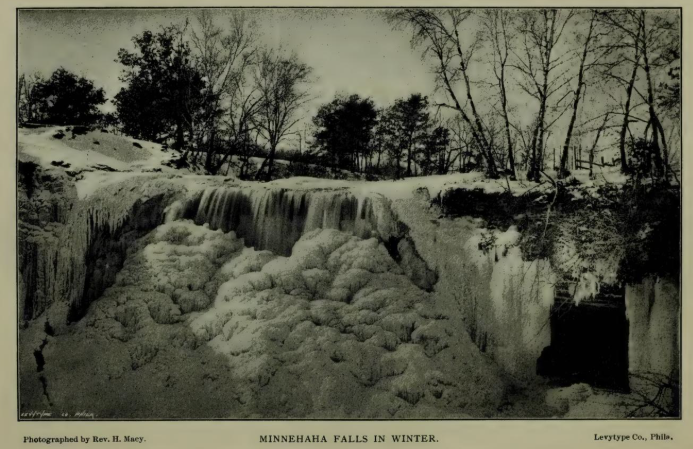
🖌 Worth a thousand words: 19th-century descriptions of Minnehaha Falls in winter
It's hard to put the splendor of a frozen Minnehaha Falls into words. But plenty have tried.

Minnehaha Falls is sometimes cited as the state’s most photographed location, and indeed, it's been a muse for photographers since the earliest days of the technology. But it's also a frequent object of prose, especially during its tourism heyday in the second half of the 19th century, when its prominence in Henry Wadsworth Longfellow’s epic 1855 poem Song of Hiawatha attracted curious onlookers from around the world.
Most came during the summer, especially in the pre-railroad days when the only way to reach the area was by steamboat, and marveled at the verdant greenery and powerful rush of the creek over the falls, before the creek had been dammed and shrunk. But a smaller subset made the trek in the winter when, as connoisseurs of staring at the falls know, the place really becomes a marvel.
And they made dispatches back home, splashed across the front pages of faraway newspapers and inside travel guides, tripping over themselves to put the magic of the frozen falls into word and sentence. Much of the resulting writing is as baroque as the frozen display itself, with the breathless, stream-of-consciousness quality of something furiously jotted down without the benefit of a backspace key. But considering the effort it took to reach the place in this era, and the objective splendor of what they'd beheld, you can't blame the more literarily-inclined of visitors for trying to squeeze every drop of purple prose from the experience.
Below are snippets of a handful of those writings, from 1860 to 1894, presented in chronological order.
Subscribe to Longfellow Whatever.
Subscribe to Longfellow Whatever for news about the fine-grained details of life in Longfellow. (Frequently asked questions)
SubscribeAlready have an account? Log in